Disposal Blog
Piano Disposal in Zurich: Costs & Transport Solutions for Heavy Pianos
Learn piano disposal costs, why specialist transport matters and how the process really works.
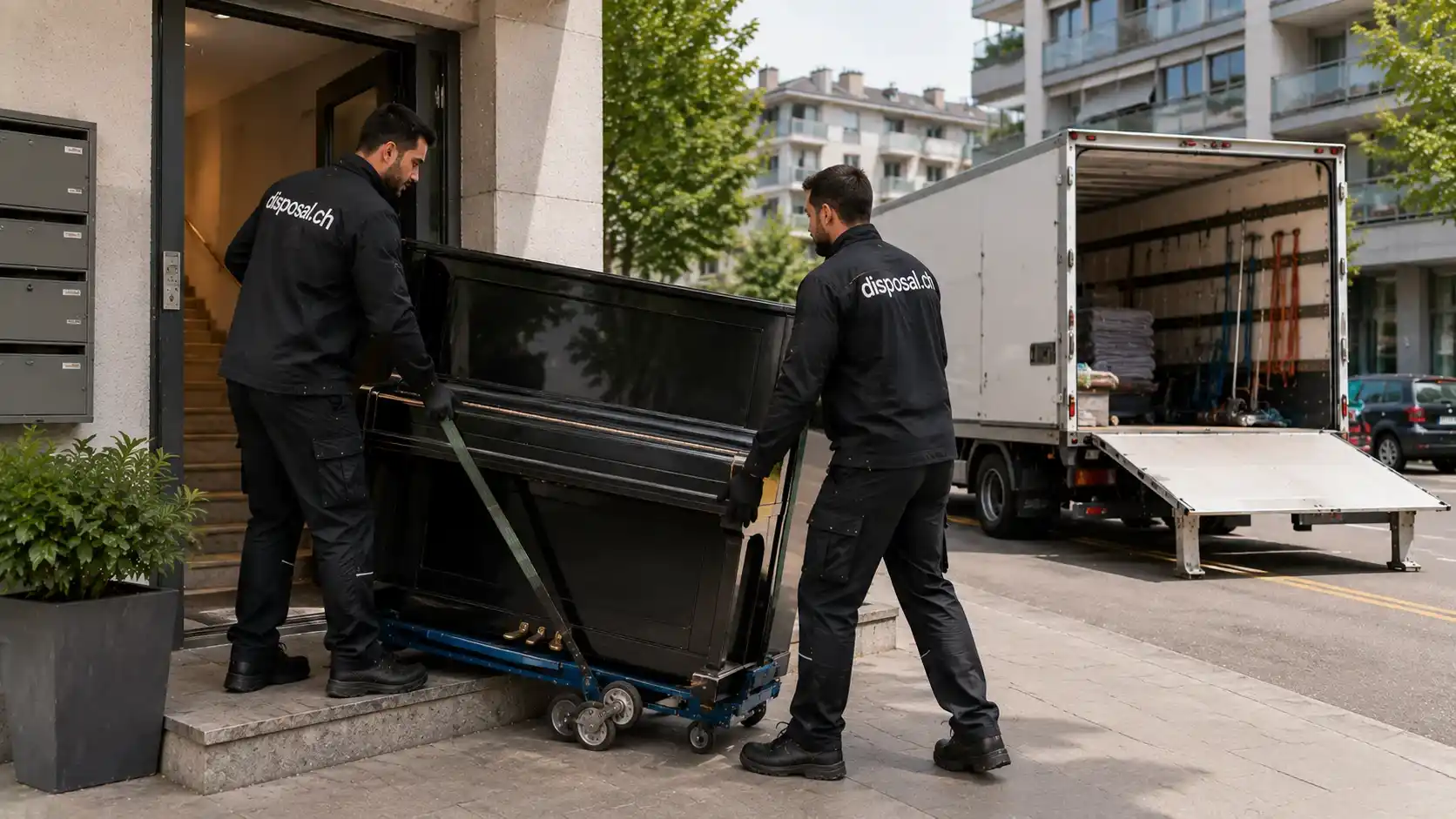
There's something genuinely ironic about piano disposal: an instrument that once cost several thousand francs and that many families keep for decades has become one of the hardest things to get rid of responsibly in Zurich. Brockenhaus shops routinely turn pianos away, private listings on Tutti often go unanswered, and the municipal Sperrgut system simply isn't built for something this heavy.
This guide explains honestly why piano disposal services in Zurich are a genuinely different problem from ordinary furniture removal, what it actually costs for upright and grand pianos, and how specialist transport handles staircases, narrow doorways, and floors without a lift.
Why a Piano Isn't Regular Bulky Waste
A piano weighs roughly 200 to 500 kg, built around a solid cast-iron frame with a genuinely delicate internal mechanism. That alone puts it well outside the 40 kg per item limit that applies to standard Sperrgut collection and Recyclinghof drop-off, covered in our guide to what counts as bulky waste in Zurich. A piano simply cannot be handled through the Sperrgutmarke system or carried to the kerb like an ordinary wardrobe.
Why Brockenhaus and Private Sale Rarely Work Anymore
It's worth being honest about this before exploring other routes. Second-hand pianos are in genuine oversupply in Switzerland: most Brockenhaus shops decline them outright, since resale value rarely covers the cost of accepting, storing, and handling something this heavy. Private sale listings frequently go unanswered for the same reason; there are simply more used pianos looking for homes than people looking to buy one.
What Piano Disposal Actually Costs in Zurich
|
Piano Type |
Typical Weight |
Disposal Cost Range (CHF) |
|
Upright piano (Pianino) |
200 – 300 kg |
Starting from 250 |
|
Grand piano (Flügel) |
300 – 500 kg |
Starting from 500 |
The largest share of that cost isn't a disposal fee at all; it's transport from the instrument's position to the vehicle: navigating stairwells, doorways, and the loading process itself. A ground-floor piano with a wide doorway costs meaningfully less to remove than the same instrument on a fourth floor with no lift.
What Drives the Price
• Piano type: grand pianos cost more to remove than uprights, due to weight and the specialised sled equipment involved
• Floor level and lift availability: higher floors cost more, unless a lift is genuinely large enough for the piano itself
• Doorway and staircase width: narrow turns sometimes require routing the piano through a balcony or window instead
• Whole-piece vs. disassembly: professionals generally move a piano intact where possible, but disassembly into individual parts is sometimes the only realistic option in a tight space
Key Takeaway
Two identical upright pianos can cost very differently to remove, one from a ground-floor flat with a wide door, the other from a third-floor walk-up with a tight stairwell turn. Access, not the instrument itself, usually decides the final price.
The Professional Process
A site visit or detailed photo assessment is typically the first step, partly to plan the safest route out, and partly because it's always worth checking whether an instrument has genuine resale or antique value before it's disposed of. Once the route is confirmed, whether that's through the front door, down a stairwell, or via a balcony or window, the team plans whether to move the piano whole or disassemble it first.
Special Equipment Needed
• Piano dollies and transport wheels, to move the instrument without dragging or tipping it
• Carrying straps, distributing weight safely across the team during stairwell sections
• A piano skid (Flügelschlitten) for grand pianos, protecting the frame during transport
• A furniture lift (Möbellift), used when stairwells or doorways genuinely can't accommodate the piano, lifting it externally via a window or balcony instead
• Air-suspended transport vehicles, reducing vibration and shock once the piano is loaded
What Happens to a Disposed Piano
Once removed, a piano is broken down for material recovery: the wooden case and soundboard are processed as wood waste, the strings and metal frame components are recycled as scrap metal, and the cast-iron frame itself is recovered separately given its weight and material value. Older pianos with ivory-topped keys need particular care during this process, since genuine ivory is subject to separate handling rules.
The disposal.ch Approach
For anyone facing a piano that's simply become too much to deal with, a fixed-price professional pickup removes the guesswork. A photo sent on WhatsApp gets a quote confirmed within the hour, factoring in floor access and instrument type from the start, so the number agreed on is the number paid, with no surprise charges once the team sees the staircase in person. This works equally well as part of a broader apartment clearance or a basement that's been storing an old instrument for years.
A Real-World Scenario
A family inherits an upright piano stored in a third-floor flat with no lift and a narrow stairwell turn. After a Brockenhaus decline and a silent Tutti listing, a single fixed-price booking handles the assessment, the specialist carry-down using straps and a dolly, and full disposal in one visit.
Conclusion
A piano's weight and construction put it firmly outside the ordinary Sperrgut and Recyclinghof system, which is exactly why Brockenhaus refusals and unanswered Tutti listings are so common. Realistic disposal costs run from CHF 250 for a straightforward upright to CHF 1,200 for a grand piano with difficult access, with transport logistics, not the instrument itself, setting the final price. A specialist team with the right equipment can handle the whole process safely in a single visit.
Get a fixed-price quote for your piano disposal or clearance in Zurich today, send us a photo on WhatsApp, and we'll confirm your price within the hour. Book your fixed-price pickup here.
Frequently Asked Questions
Why can't a piano go out as regular Sperrgut in Zurich?
A piano weighs roughly 200 to 500 kg, far above the 40 kg per item limit for standard Sperrgut collection, and needs specialist equipment rather than a kerbside sticker.
How much does piano disposal cost in Zurich?
An upright piano typically costs CHF 250 to 700, and a grand piano CHF 500 to 1,200, with floor access and doorway width being the biggest factors in the final price.
Will a Brockenhaus take my old piano?
Usually not. Most second-hand shops decline pianos due to genuine oversupply and the cost of handling something this heavy relative to its resale value.
Can a piano always be moved through a normal doorway?
Not always. Narrow stairwells or doorways sometimes require routing the piano through a balcony or window using a furniture lift instead.
What happens to a piano once it's disposed of?
It's broken down for material recovery: the wooden case as wood waste, and the strings, frame, and metal components recycled as scrap metal.
